15 Weird and Wonderful Christmas Card Facts (Yes, Including Krampus)
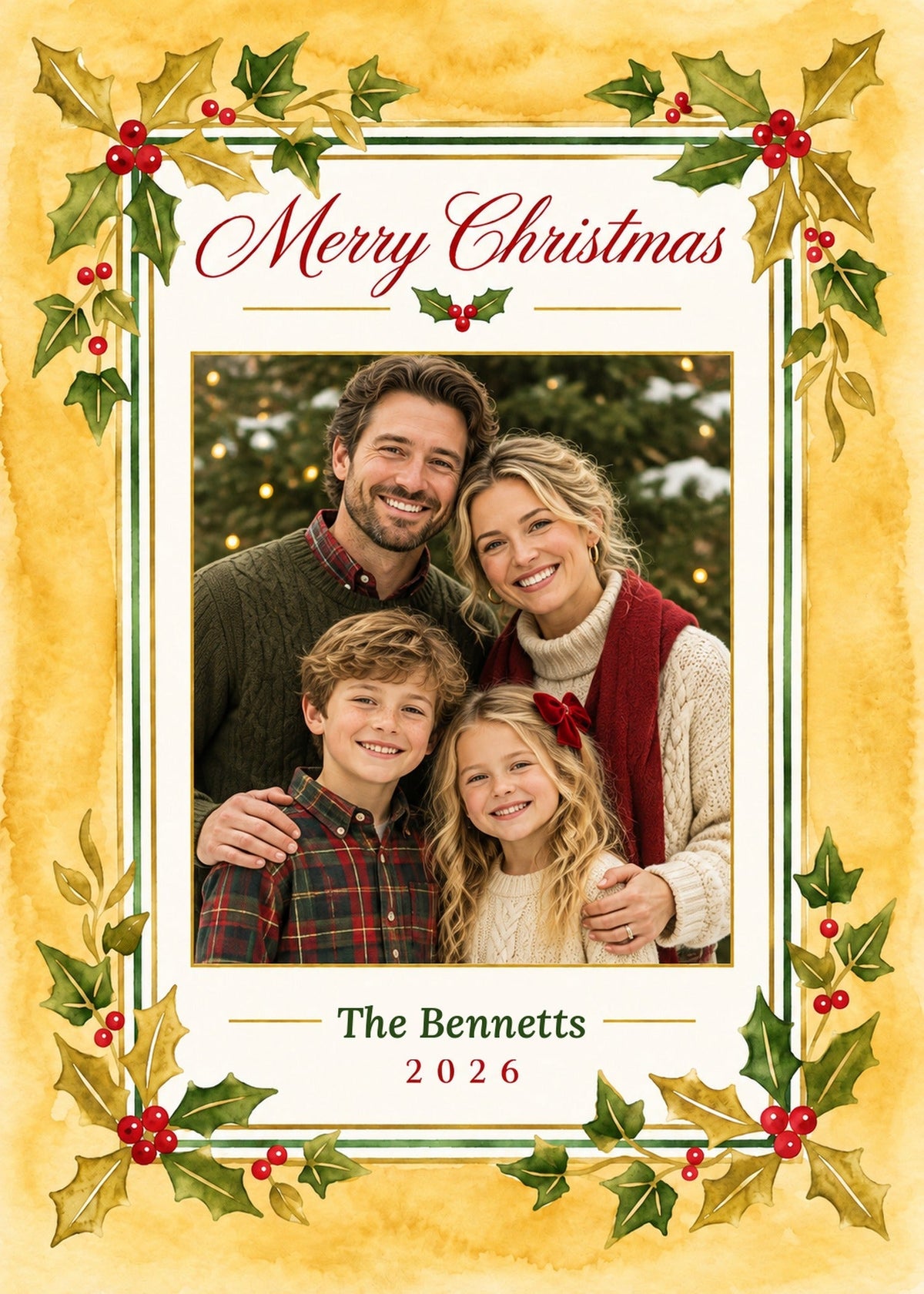
We love a good Christmas card at Jingle Prints. (The elves at The Christmas Collective have opinions about envelopes.) So we went digging into where the tradition came from, and it turns out Christmas card history is much stranger than robins and snowflakes. Here are 15 true facts, with dancing frogs, a holiday demon, a royal signing marathon and a card so small it got lost inside a microscope.
Where it all started
1.The first known Christmas greeting was shaped like a rose
Back in 1611, a German doctor and alchemist named Michael Maier sent a Christmas greeting to King James I and his son, Prince Henry. It wasn't a folded card. It was a manuscript with the Latin greeting written out so the words formed the shape of a rose. It sat in the Scottish Record Office, unnoticed, until a researcher found it in 1979.
2.The first card you could buy was invented by a man who was too busy to write letters
In 1843, Sir Henry Cole, who later became the first director of London's Victoria and Albert Museum, had more Christmas letters to answer than he had time for. So he asked his artist friend John Callcott Horsley to design a printed greeting instead. They had 1,000 copies made and sold the extras for a shilling each, which was a lot of money for most families at the time.
3.That very first card caused a scandal
The center picture showed a family raising a toast, and the children were holding glasses of wine too. The temperance movement was growing at the time, and some people were not amused. The card sold anyway, and more were printed to keep up with demand.
4.It came out the same week as A Christmas Carol
Charles Dickens published A Christmas Carol in December 1843, and Cole's card is believed to have gone on sale that very same week. It was a big year for Christmas.
5.Hardly any of the originals survive
Of those first 1,000 cards, only around 21 are known to still exist. One sold at auction in England in 2001 for £22,500. Not bad for something that started as a time-saver.

The wonderfully weird Victorian years
6.Victorians sent bugs, frogs and walking potatoes
Victorian Christmas cards could feature almost anything. Dancing insects, frogs (some of them fighting), mice riding lobsters, Christmas puddings with faces and even walking potatoes all turn up on real cards from the 1800s. Snowy scenes and Santa weren't the standard yet, so artists drew whatever they thought was charming or funny.
7.Some cards starred a holiday demon
In Austria and Germany, cards often featured Krampus, the horned, goat-like creature who, in folklore, comes for naughty children while Saint Nicholas rewards the good ones. Cards reading "Gruß vom Krampus," or "Greetings from Krampus," were a real thing.
8.Cards came with silk, tassels and moving parts
As printing got cheaper, the Victorians wanted more and more novelty. Cards were trimmed with silk fringe, lace, ribbons and tassels. Some were scented or decorated with pressed flowers, some were cut into shapes like fans or purses, and some had pull-tabs and flaps that moved when you opened them.
9.America didn't sell Christmas cards until 1874
A Boston printer named Louis Prang began selling Christmas cards in the United States in 1874, and he's often called the "father of the American Christmas card." By the 1880s his shop was turning out more than five million cards a year. One of his designs shows a parade of frogs marching with a banner and a band.

Cards that made history
10.The best-selling Christmas card ever has three little angels on it
According to Hallmark, its "Three Little Angels" card from 1977 is the best-selling Christmas card of all time, with more than 34 million sold. Two of the angels are praying, and the third peeks out at you with her halo a little crooked.
11.The Kennedys' 1963 Christmas cards were never sent
John and Jacqueline Kennedy had already ordered their 1963 Christmas card, showing the nativity scene in the White House East Room. It was the first time a religious image had been chosen for a White House card. They signed only about 30 of them before leaving for Dallas in November, and the cards were never mailed.
12.During World War II, Parliament argued about Christmas cards
Paper was badly rationed in wartime Britain. In 1940, a member of Parliament asked the Postmaster General to tell the public to stop sending Christmas cards altogether. He refused, partly because so many children had been sent away from their families for safety and cards helped keep them in touch. The cards that were made got smaller and were printed on thin paper.
13.Queen Elizabeth II signed around 750 cards every year
The late Queen and Prince Philip sent around 750 Christmas cards a year, usually with a family photo, and she signed them herself. She was reported to start in the summer at Balmoral to get through them all. Officials got "Elizabeth R," friends got "Elizabeth," and her cousins got her family nickname, "Lilibet."
Today's tiniest and biggest
14.The world's smallest Christmas card got lost in a microscope
In 2017, scientists at the UK's National Physical Laboratory made a Christmas card just 15 by 20 micrometers. That's so small you could fit more than 200 million of them on a postage stamp. It has a snowman and "Season's Greetings" on the front, and when the team tried to photograph it with an electron microscope, it popped off its stand and disappeared somewhere inside the machine.
15.The UK throws away about a billion Christmas cards every year
The UK government estimates that around 1 billion Christmas cards are thrown away each year after the holidays, and that it would take the equivalent of 33 million trees to make that much card. It's a good reason to keep your favorites, recycle the rest, or send a printable card that's easy to print just as many as you need.

Make your own Christmas card history
Our printable Christmas cards and photo cards are instant downloads. Add your photo and family name, print as many as you need, and send something pretty this year. Frogs optional. And 100% of the profits go to The Great Christmas Project to give kids a Christmas morning.
Shop Christmas card designsSources: Wikipedia, Christmas card; The Postal Museum; History of Information; London Museum; History.com; World History Encyclopedia; Wikipedia, Louis Prang; Mental Floss; Smithsonian Magazine; UK Parliament, Hansard 1940; The Royal Family; Guinness World Records; GOV.UK.